America's First Civilization by Michael D. Coe
Author:Michael D. Coe [Michael D. Coe]
Language: eng
Format: epub
Tags: History/Americas
ISBN: 9781640190009
Publisher: New Word City, Inc.
Published: 2017-01-17T05:00:00+00:00
It is time now to talk of my own role in this story. I have been fascinated by the Olmec since I was a graduate student in anthropology, particularly after reading Covarrubias’s exciting book, Mexico South. As I learned more about this controversial civilization, a conviction grew that Covarrubias, Caso, and Stirling had been right about it all along. For three subsequent field seasons I “labored in the vineyards,” digging relatively simple Formative-stage sites on the Pacific Coast of Guatemala and in northwestern Costa Rica, until I was fairly certain about what pottery and other materials from this remote epoch should look like. Then in 1964, I decided to concentrate on San Lorenzo.
San Lorenzo is not one, but a group of three related archeological sites. To reach the area, one travels to the grimy oil town of Minatitlán, situated on the Coatzacoalcos River about twenty-five miles above its mouth. Here one must search out and hire a dilapidated diesel boat that are the main form of transport on the river. The Coatzacoalcos and its tributaries drain all of the northern half of the Isthmus of Tehuantepec; at one point in its course, the river splits and flows about a large, swampy island called Tacamichapa, reputed by the local people to have belonged to Doña Marina, the famous Indian mistress of Cortés. The west branch, which skirts Tacamichapa, is the Chiquito River, and the boat enters it after two hours of travel. After another three to four hours, passing between banks lined with fields of tall corn alternating with patches of green jungle, the boat touches at its destination, the village of Tenochtitlán. This was our home for three seasons of excavations (1966-1968).
Walking up from the river edge through the village, one immediately notices that all of the native houses, built of poles or boards and thatched with palm fronds, are placed on artificial mounds, some of them quite high and long. Tenochtitlán is one of the three ancient sites in the area. It was so-named by a local schoolteacher, who, noting the size and number of ancient mounds there, decided that it must have been a great ancient city and so erroneously named it after the Aztec capital.
San Lorenzo is another of the archeological sites in the area, located one and a half miles south-southwest of Tenochtitlán. The third is the little, palm-shaded village of Potrero Nuevo, one and three-quarter miles east-southeast of San Lorenzo. They are known collectively to archeologists as San Lorenzo Tenochtitlán.
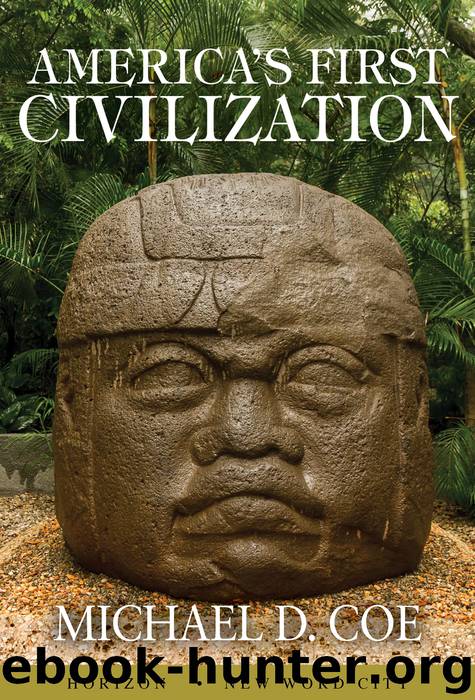
Again, it was Stirling who discovered the San Lorenzo Tenochtitlán group in 1945, having heard rumors in Coatzacoalcos that there had been found some large carved stones upriver in that zone. By spring of the next year, Stirling, accompanied by his wife, Marion Illig, and Philip Drucker, had uncovered fifteen of the finest Olmec basalt monuments ever seen, including five of the largest and most beautiful Colossal Heads known to date. While the 1946 project was devoted to excavations at the most important site, San Lorenzo
Download
This site does not store any files on its server. We only index and link to content provided by other sites. Please contact the content providers to delete copyright contents if any and email us, we'll remove relevant links or contents immediately.
| Africa | Americas |
| Arctic & Antarctica | Asia |
| Australia & Oceania | Europe |
| Middle East | Russia |
| United States | World |
| Ancient Civilizations | Military |
| Historical Study & Educational Resources |
The Daily Stoic by Holiday Ryan & Hanselman Stephen(3362)
The Fate of Rome: Climate, Disease, and the End of an Empire (The Princeton History of the Ancient World) by Kyle Harper(3089)
People of the Earth: An Introduction to World Prehistory by Dr. Brian Fagan & Nadia Durrani(2759)
Ancient Worlds by Michael Scott(2719)
Babylon's Ark by Lawrence Anthony(2718)
The Daily Stoic by Ryan Holiday & Stephen Hanselman(2704)
India's Ancient Past by R.S. Sharma(2492)
Foreign Devils on the Silk Road: The Search for the Lost Treasures of Central Asia by Peter Hopkirk(2482)
MOSES THE EGYPTIAN by Jan Assmann(2448)
The Complete Dead Sea Scrolls in English (7th Edition) (Penguin Classics) by Geza Vermes(2310)
The Earth Chronicles Handbook by Zecharia Sitchin(2255)
Lost Technologies of Ancient Egypt by Christopher Dunn(2251)
24 Hours in Ancient Rome by Philip Matyszak(2100)
Alexander the Great by Philip Freeman(2086)
Aztec by Gary Jennings(2056)
The Nine Waves of Creation by Carl Johan Calleman(1936)
Curse Tablets and Binding Spells from the Ancient World by Gager John G.;(1884)
Before Atlantis by Frank Joseph(1878)
Earthmare: The Lost Book of Wars by Cergat(1842)
